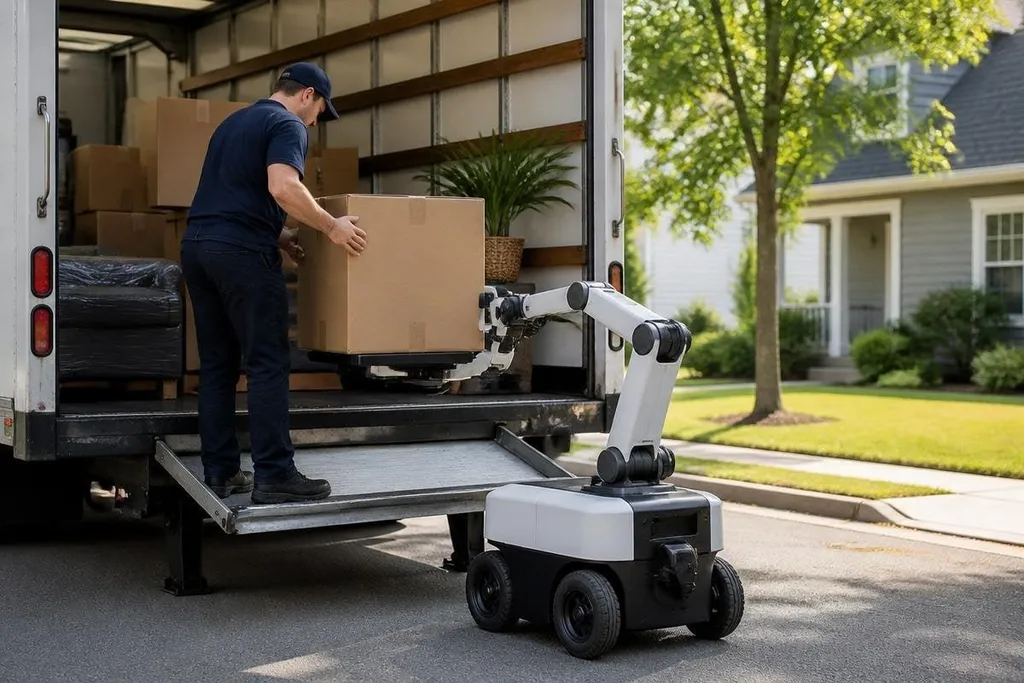
A moving robot has to do more than carry a box across a room. It must find the box, grip it without damage, avoid people, fit through doors, and place it in a truck or new home.
For someone planning a move, that makes the useful question practical: which parts of the job can a robot handle safely, and where will a person still need to take over?
- Early services will likely focus on lifting and carrying heavy items.
- Cameras, LiDAR, and force sensors will help robots work around people and furniture.
- Packing judgment, fragile objects, stairs, and poor access will remain hard problems.
The first useful job is moving heavy items
Household moves contain many objects with simple paths but awkward weight. A robot could lift a sealed box from the floor, carry it to a loading area, and place it on a dolly or lift gate. The value comes from reducing repeated lifting, not from removing every person from the job.
That task still needs clear limits. It must know the box weight, keep its grip as the load shifts, and stop when a person enters its path. A human worker would also need a way to guide the robot when an object has an uneven shape or a damaged carton.
The same approach could work for sofas, appliances, and storage bins if the robot has enough payload and a gripper suited to each object. Those requirements are different from carrying standard cartons, so one machine may not handle an entire household without tool changes or human help.
A moving robot needs a map and a plan
A warehouse gives a robot marked routes and repeatable shelves. A home gives it narrow halls, loose cables, rugs, pets, glass doors, and furniture that may move during the job.
Cameras can identify objects, while LiDAR measures room shape and distance. Software then builds a map for each room.
Mapping alone doesn't solve the job. It also needs to choose where to stand, how to turn a sofa, and which path keeps the load clear of walls. A moving crew could mark safe zones, open doors, and tell the system which items must stay upright.
Remote control may fill the gaps. A person could take over for a tight doorway or a difficult handoff, then return control to the robot for a clear route. That model keeps the machine doing repeated physical work while a trained operator handles decisions that software cannot confirm.
Those handoffs still need proof in real homes, where door frames, stairs, boxes, and people can change the task. Moving robot reports from Robot24.com can tie those limits to named machines and test settings before the packing work begins.
Packing is harder than carrying
A box has a known shape and a fixed label. A kitchen drawer does not. It may contain sharp tools, loose parts, or objects that need separate wrapping. A robot can pick up a known item, but deciding how to protect an unknown household object requires more than arm movement.
Fragile goods create another limit. A gripper must apply enough force to hold a plate or lamp, but not enough to crack or bend it. Force sensing can help, yet the robot still needs information about the material and condition of the object.
Stairs create a separate problem. A wheeled platform may need a ramp or lift, while a legged robot must keep its balance with a load. Neither approach removes the need for site checks, since a robot that works on one staircase may not fit the next one.
What the service may look like
A practical moving service may divide the work between people, machines, and remote operators. It could handle repeated lifting and short carries. Workers could pack fragile items, make decisions about placement, and check the load before transport.
The business model will depend on more than the robot itself. A provider must account for setup time, charging, repairs, insurance, remote supervision, and damage claims. If a machine needs a worker beside it for every box, the service may save less labor than its sales pitch suggests.
I'd wait for a service to publish task limits, damage records, human supervision rules, and repair costs before booking it for a full household move.
A buyer's checklist
Before choosing a robot-assisted moving service, check these points:
- Ask which tasks the robot performs without remote control.
- Confirm the maximum payload and the smallest doorway it can use.
- Check how workers protect glass, electronics, and other fragile goods.
- Find out who pays when the robot damages furniture or walls.
- Ask how the service handles stairs, lifts, pets, and blocked routes.
- Request a clear plan for charging, delays, and human assistance.
The first useful version of robot-assisted moving will probably look like a moving crew with a lifting machine, not a fully automatic household move. The test that matters is simple: can it complete a defined task safely, across different homes, without hiding the cost of the person standing nearby?